

Introduction
Transforming a sophisticated interface into a high-performing eCommerce storefront requires far more than copying layouts. When brands attempt to convert figma design to shopify theme, they often underestimate the technical architecture, performance engineering, and conversion psychology required to build a truly scalable shopify store.
A beautifully crafted prototype inside figma does not automatically translate into a high-converting storefront on Shopify. The gap between design intent and commercial execution is where most businesses lose momentum.
If your goal is to launch a revenue-driven shopify store, not just a visually appealing one, understanding these critical mistakes will protect your investment and elevate your brand authority.
Treating Design as a Static Blueprint
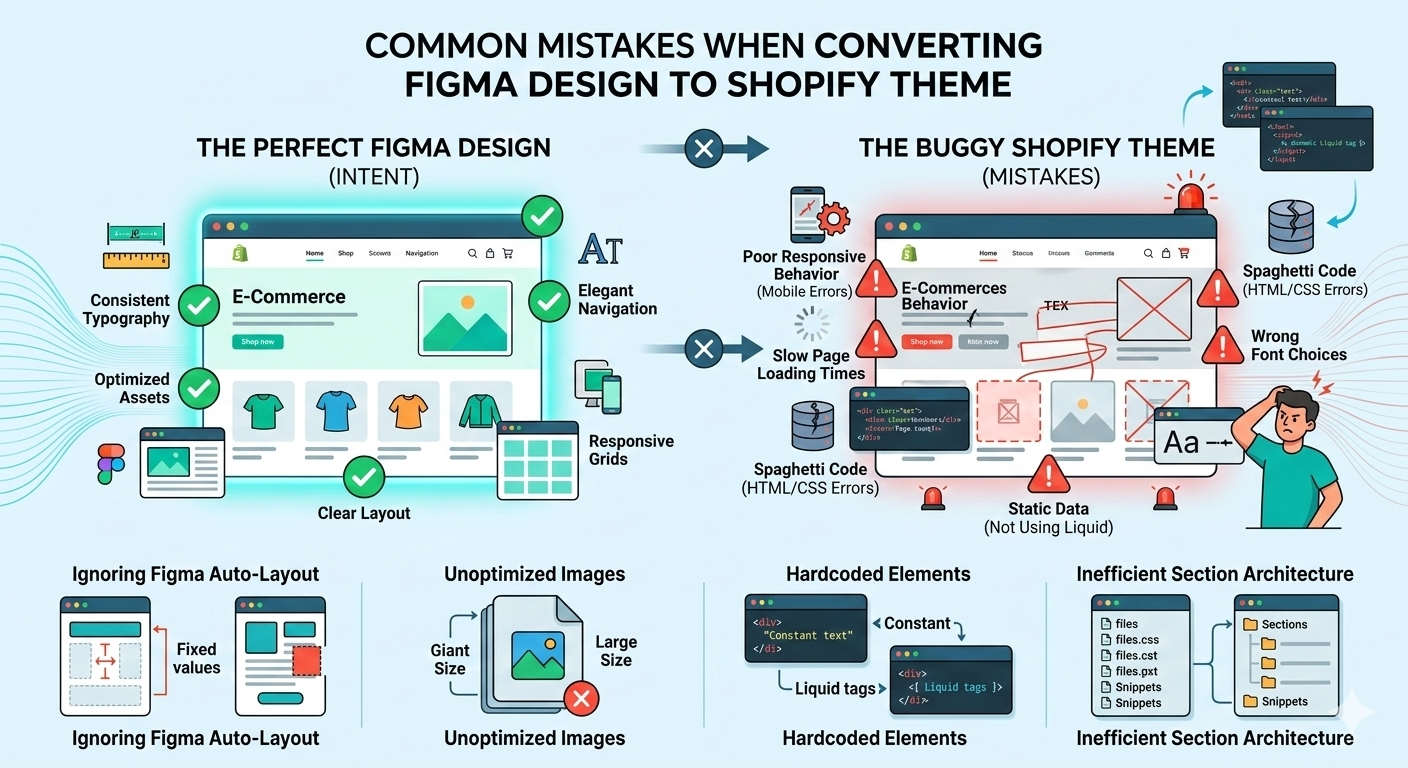
One of the most fundamental errors when businesses convert figma design to shopify theme is assuming the design is a rigid blueprint.
figma files are static representations. shopify stores are dynamic systems powered by product databases, user behavior, and conditional logic.
A design that looks flawless in preview mode can collapse when confronted with:
- Variable product titles
- Dynamic pricing rules
- Multiple product variants
- User-generated reviews
- Long-form descriptions
Professional conversion requires flexibility. Containers must expand gracefully. Layouts must adapt intelligently. Your theme must accommodate real-world commerce, not idealized mockups.
Ignoring shopify's Native Architecture
shopify's modern framework supports modular sections, JSON templates, and flexible customization through its theme editor.
When developers hardcode layouts instead of embracing shopify's native structure, the result is a rigid store that cannot evolve. Businesses that convert figma design to shopify theme without respecting the shopify Online Store architecture limit future scalability and increase dependency on developers.
A strategically built theme enables:
- Drag-and-drop sections
- Editable content blocks
- App integration zones
- Future layout adaptability
Scalability should be engineered from day one.
Weak Liquid Implementation
shopify runs on Liquid, its templating language. Poor Liquid structuring is one of the most expensive long-term mistakes during a figma-to-shopify transition.
Common development flaws include:
- Redundant loops
- Heavy conditional rendering
- Hardcoded data
- Inefficient filters
When you convert figma design to shopify theme without disciplined Liquid coding, you introduce performance bottlenecks and technical debt.
Clean Liquid logic ensures maintainability, speed, and compatibility with shopify updates.
Overlooking Performance Engineering
Aesthetic perfection means little if your store loads slowly.
During the process to convert figma design to shopify theme, many teams focus on design fidelity while neglecting optimization. This is a silent revenue killer.
Below is a performance optimization comparison that separates amateur builds from professional implementations:
| Performance Area | Common Mistake | Strategic Implementation | Business Result |
|---|---|---|---|
| Image Assets | Large PNG exports | WebP compression & scaling | Faster load time |
| Typography | Multiple font families | Minimal optimized font stack | Reduced render blocking |
| Scripts | Global JavaScript loading | Conditional loading strategy | Lower interaction delay |
| Apps | Excessive third-party apps | Lean custom integrations | Improved stability |
| CSS | Heavy monolithic file | Modular minified structure | Faster Rendering |
Page speed influences:
- Conversion rate
- Search rankings
- Ad campaign performance
- Customer retention
Performance is not optional. It is competitive advantage.
Designing for Desktop Instead of Mobile Commerce
Modern shopify stores receive the majority of traffic from mobile devices. Yet many brands still prioritize desktop aesthetics.
When you convert figma design to shopify theme, mobile-first strategy must lead development, not follow it.
High-converting mobile themes prioritize:
- Thumb-accessible CTAs
- Sticky add-to-cart functionality
- Minimal scrolling friction
- Collapsible information blocks
- Clean visual hierarchy
Neglecting SEO Architecture
Design is visible. SEO is structural.
One of the most damaging mistakes when businesses convert figma design to shopify theme is failing to integrate search engine optimization during development.
Critical SEO elements include:
- Proper H1 hierarchy
- Structured data markup
- Optimized meta templates
- Canonical tag control
- Clean URL structures
- Internal linking logic
Without semantic HTML and schema implementation, your store's discoverability suffers regardless of visual brilliance.
Hardcoding Editable Elements
A professional shopify theme empowers marketing teams to update content without developer intervention.
However, many rushed conversions lock banners, testimonials, promotional strips, and FAQs into hardcoded templates.
When you convert figma design to shopify theme correctly, content flexibility must be built into the theme editor.
This ensures agility in campaigns, seasonal updates, and product launches.
Ignoring Conversion Psychology
A design can be elegant yet commercially ineffective.
When businesses convert figma design to shopify theme, they often preserve layout aesthetics but ignore behavioral triggers.
High-converting themes integrate:
- Trust badges near CTAs
- Social proof sections
- Urgency messaging
- Clear benefit-driven product descriptions
- Strategic upsell placements
Conversion architecture is intentional. Every element should guide purchasing behavior.
Failing to Prepare for App Integrations
shopify's ecosystem thrives on applications subscriptions, reviews, email marketing, loyalty systems, and inventory tools.
If you convert figma design to shopify theme without planning structural space for app blocks, layout conflicts arise.
Theme architecture must anticipate:
- Review widgets
- Subscription selectors
- Dynamic pricing tools
- Popup integrations
Compatibility prevents future redesign expenses.
Skipping Staging and Version Control
Professional shopify development never happens directly on a live store.
When businesses convert figma design to shopify theme without:
- Staging environments
- Version control systems
- Backup workflows
They risk downtime, broken layouts, and lost revenue.
Technical discipline separates enterprise-grade execution from amateur deployment.
Underestimating Long-Term Scalability
Your store may launch small, but growth must be anticipated.
A properly structured theme can handle:
- Expanding collections
- Advanced filtering
- Multilingual capabilities
- International pricing
- High traffic volumes
When you convert figma design to shopify theme, you are not building for today; you are engineering for scale.
Strategic Closing Perspective
To successfully convert figma design to shopify theme, you must merge design precision with technical intelligence and commercial strategy.
A shopify theme is not a visual replica. It is a performance engine.
The difference between a basic conversion and a revenue-generating shopify storefront lies in:
- Clean architecture
- Performance optimization
- SEO integration
- Mobile-first design
- Conversion psychology
- Scalability planning
Treat this transition as a strategic build, not a design export.
If executed correctly, your shopify store becomes more than a website; it becomes a growth infrastructure capable of supporting sustained digital expansion.
FAQ
01. What does it mean to convert Figma design to shopify theme?
It means transforming a visual design created in figma into a fully functional, dynamic shopify storefront built on shopify using Liquid, sections, and theme architecture.
02. How long does it take to convert figma design to shopify theme?
A standard project typically takes 2-4 weeks, depending on design complexity, custom features, app integrations, and performance optimization requirements.
03. Why is my shopify store slow after theme conversion?
Common causes include unoptimized images, excessive apps, poor Liquid coding, and heavy JavaScript. Performance optimization must be handled during development, not after launch.
04. Can I edit content after converting figma to shopify?
Yes, if the theme is built correctly using shopify's section-based architecture. A professional conversion allows you to update banners, text, products, and layouts directly from the theme editor.
05. Is coding required to convert figma design to shopify theme?
Yes. The process requires HTML, CSS, JavaScript, and shopify's Liquid templating language to create a fully functional, scalable store.
06. Will SEO be affected during theme conversion?
It can be if not handled properly. Proper heading structure, schema markup, meta tags, and semantic HTML must be integrated during development to protect rankings.
07. Will SEO be affected during theme conversion?
It can be if not handled properly. Proper heading structure, schema markup, meta tags, and semantic HTML must be integrated during development to protect rankings.